[Fox News]
Home to PointNiner

It's political convention season and if you're a delegate, like Jerry Springer, and you've flown into either Denver or Minneapolis/St. Paul recently, you may have noticed something new and different from our beloved TSA. In an attempt to bolster security for the added masses transiting these airports, the agency decided to throw in a few new technological gizmos like passive millimeter wave radar. This portable system, also known as standoff detection technology, measures energy generated by the human body to detect explosives hidden on a person. Used for years in other environments, this is the first time it has been employed at U.S. airports. The TSA claims the devices are safe and non-invasive, but don't be surprised if you develop webbing between your toes after getting a dosage. Another new gadget being used is the hand-held spectrometer which has the ability to penetrate sealed containers using laser technology to detect solid and liquid explosives. It cannot, however, tell you what's in that old tupperware dish that's been in your fridge for the last six months. Of course, not to be outdone by all of it's new toys, the TSA has had their Transportation Security Officers screeners at Denver and Minneapolis break out the controversial new uniforms to highlight their professionalism to the delegates and politicians alike. Convinced?
[Evolution of Security]
This Friday marks the deadline for Southwest Airlines to pay the $10.2 million fine imposed by the FAA for failure to comply with its maintenance program and flying uninspected aircraft. Southwest does not intend on paying the fine, however. If you recall from the PointNiner archives, this scandal set off an embarrassing chain events both within the FAA and the airlines that led to numerous aircraft inspections and even some additional fines for other airlines. As far as the hefty price Southwest was slapped with, the airline is saying they plan on fighting it. A Wall Street Journal article claims a Southwest spokeswoman as saying "we simply don't agree with [the penalty] and want to talk about it further." The FAA hasn't said what they would do if Southwest doesn't pay up by Friday, but they do have a few options in their deck. The Journal says "typically, the next step is for the agency to ask the Justice Department to file suit on its behalf. With a number of other sizable enforcement cases already pending against other carriers it would be problematic for the FAA's leadership to back down now.” The other option, which is dicey, is to threaten to revoke Southwest's operating certificate but would require some major cojones on the part of the FAA. Let's sit back and see what happens next.
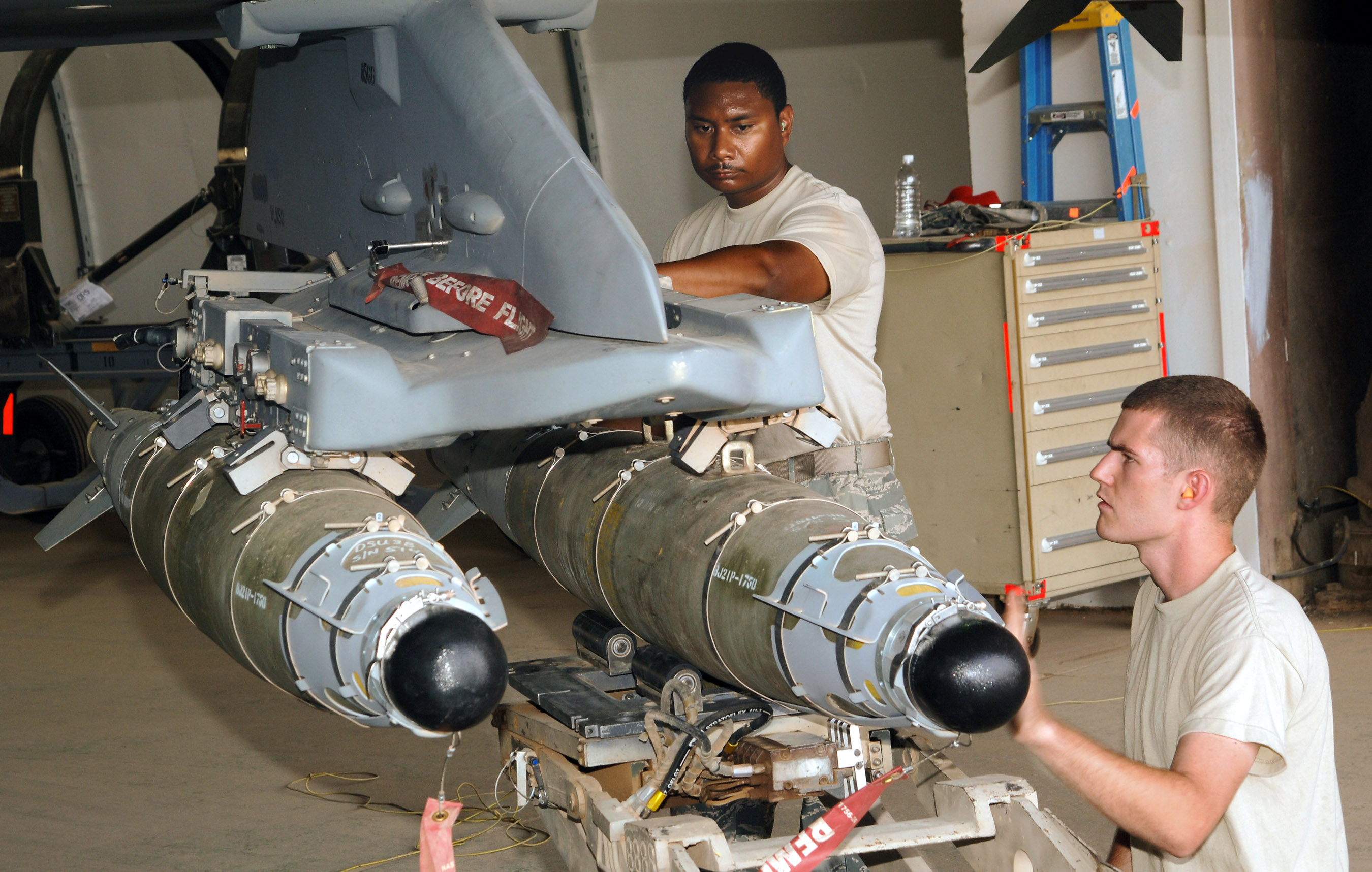
The two main types of precision guided bombs in the US arsenal today are guided by either GPS or lasers. But what if there was a way to combine the two on one bomb? That's exactly what the USAF did when it developed the GBU-54 Laser Joint Direct Attack Munition. The GBU-54 is essentially a 500-lb dummy bomb with a strap-on GPS guided tail and a laser guidance sight mounted to the tip. On August 12th this new munition scored its first kill when an F-16 from the 77th Expeditionary Fighter Squadron at Balad Air Base destroyed a "moving enemy vehicle in the Diyala province to support a combined Iraqi army and U.S. Marine operation." An urgent operational need for this type of munition was identified in 2007 and took only 17 months of testing and development before it was in theater for deployment. Lt. Gen. Gary L. North, the U.S. Air Forces Central commander and U.S. Central Commands Combined Force Air Component commander said, "The first combat employment of this weapon is the validation of the exacting hard work of an entire team of professionals who developed, tested and fielded this weapon on an extremely short timeline, based on an urgent needs request we established in the combat zone." While a regular GPS JDAM is perfect for hitting stationary targets, the new Laser JDAM allows the Air Force to strike mobile ground targets as well. This is especially crucial in the fight against VBIEDs. The footage from this engagement is allegedly depicted below.

Sikorsky's high speed technology demonstrator, the X2, made its first flight yesterday from the Schweizer Aircraft's rapid prototyping facility in Horseheads, New York. The 30 minute flight was a long awaited milestone as it was originally scheduled to take place two years ago. Designed to cruise at a whopping 250 kts, the X2 will start a test phase with work on hovering with its coaxial main rotors before completing a four phase program wrapping up with high speed flight. The test program is intended to assist Sikorsky with deciding whether or not to develop the X2 for civilian production by 2010. The X2 gets its power from a Light Helicopter Turbine Engine Co. (LHTEC) T800 engine that was originally developed for the now defunct RAH-66 Comanche helicopter. While its design is not completely original, it does feature new fly-by-wire controls and advanced avionics that engineers hope will counter the high vibration issues found in other coaxial rotor designs. Sikorsky could use the X2 as a stepping stone for both civil and military products featuring the coaxial, compound design which already improves over previous designs in the sexiness department.

Images: Sikorsky
[Flight Global]
Home to PointNiner

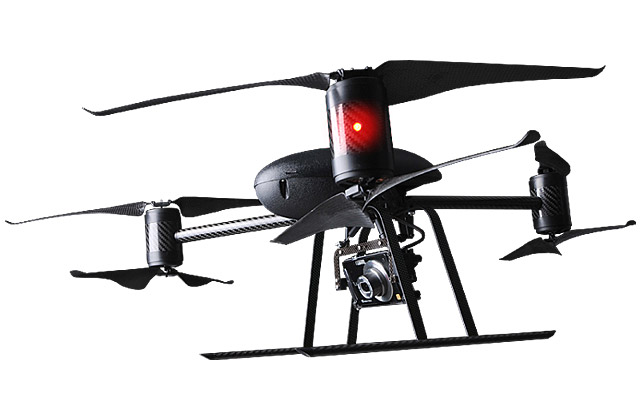
We see a lot of UAVs pop up on PointNiner, but this one has got to be one of the coolest. You've got to check out the videos on their website. They were enough to sell me on the Draganflyer X6. It's a remote controlled UAV with a carbon-fiber body that has three tips that contain two rotors each for control. The X6 has a oil-dampening vibration-killing mount that can be used to place a hi-def camera or night vision scope under the body for some James Bondish spying. It even has an on-board GPS and the ability to fly up to 30 mph as well as a 23 foot per second climb...straight up! Here you go, Aaron. This post takes all the guess work out of your Christmas shopping for me this year.
[Draganfly via Gizmodo]
Home to PointNiner
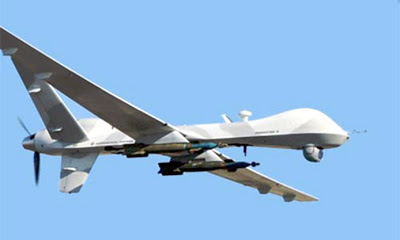
No, I'm not talking about Battle Bots here. I speaking about full on unmanned system vs. unmanned system in actual combat. This new era got off with a real bang when an MQ-9 Reaper dropped a 500-lb laser guided bomb on a remotely controlled Vehicle Borne Improvised Explosive Device (VBIED) in Iraq last week marking a historic first. The Reaper, which began combat patrols in Iraq last month is really proving its mettle to the battlefield commanders over there as it starts to assume the roles previously occupied by manned systems. 46th Expeditionary Reconnaissance and Attack Squadron Commander Lt. Col. Micah Morgan, said that they "searched for, found, fixed, targeted and destroyed a [threat] with just one aircraft." The Air Force already has an entire wing of UCAVs, but I'm thinking that's just the start. It won't be long before unmanned systems outnumber manned aircraft and pilots are exiled to air conditioned trailers where they play war half a world away. Countries around the world are following suit with development of their unmanned systems as well. Perhaps it will be the Major League Gamers that help us usher in the robotic apocalypse. Can anyone say Skynet?
[Aviation Week via Gizmodo]
Home to PointNiner
Thank goodness the boys over at Danger Room picked up on this one, because I would have died with a unfulfilled life if I had not seen it. Back in February the PBS program NOVA (one of my favorites) ran a show called Astrospies. The episode told the story of the U.S. and Soviet Union's attempts to get military spies into orbit during the 1960s. The U.S. Department of Defense tried to do this with something called the Manned Orbital Laboratory or MOL. I've heard about the MOL before through other channels but there always seemed to be a void of useful information on this secretive project, until now. The craziest part of these programs was their intentions to turn space into the eventual battlefield of tomorrow. If you're like me and a huge fan of space exploration and Cold War espionage then you've got to take an hour out of your day and geek out on Astrospies here on the NOVA site. As a bonus, you get all the sweet 1960's animations you could ever ask for.
Here's a little teaser to peak your curiosity.
If you're a PointNiner regular or subscriber and have wondered where we've been all week, don't fear. We didn't get indicted in the Patty Wagstaff Oshkosh DUI scandal as accomplices. Instead, the PointNiner crew has been on vacation. I did manage a little vacation-blogging by throwing a few things out there on Saturday and Monday, but it's been quiet around here otherwise. Things should swing back in to motion on Thursday with some more juicy aviation goodiness but you'll just have to wait until then.
I like to pride myself in the history and knowledge of aircraft, but I am always more than willing to humble myself when I find out more than I knew (or thought I knew) before. Such was the case when I saw this picture of a Boeing B-17 Flying Fortress with one single turboprop engine instead of the typical four radial engines. I assume it's some sort of test aircraft and I noted the civilian registration on the wing, but if anyone knows more about this particular aircraft, please fill me in. I found it on this website that contains rare American aircraft, the majority of which come from the WWII era or just beyond. Most of the photos I had seen before, but I was highly intrigued to see many others which were completely new to me. Here are a few more rare B-17 shots for you.
On Friday PointNiner brought you the story of an ATK sounding rocket launched from the NASA Wallops Flight Facility that didn't quite hit its mark. In fact, the Alliant Techsystems ALV X-1 rocket was abruptly terminated by the Range Safety Officer (RSO) following a "launch anomaly", according to a NASA press release. Now an amateur video has surfaced that shows the launch and subsequent abortion of the rocket that was carrying NASA's Hypersonic Boundary Layer Transition (HYBOLT) and Sub-Orbital Aerodynamic Re-entry Experiments (SOAREX). Judging by the sound delay, I'm guessing the photographer was about 1.5 to 2 miles from the launch site. Sure makes for pretty fireworks, though.

Pilots gots to have their gadgets and the Apple iPhone is by far the top gadget out there right now. PointNiner's own Senior Editor, Aaron can tell you all about this phenomenon. Well if you're a fly(boy/girl) and you've got one of these slick beauties in your paws, here are a few new applications available at the App Store that may come in handy on a cross country or at a cocktail party.
FltPlan Airport Guide: This is a handy little airport guide with every airport in the U.S. Get everything from airfield information, to radio frequencies and much, much more! Price = Free.
FAA Wait: This is an iPhone version of the popular ATCSCC site that provides real-time data on airport flight delays. Price = $1.
Gulfstream Tanker: And finally, my favorite. Don't you hate it when you're trying to figure out whether or not to fill your Gulfstream GV with fuel at your present location or at your destination? Well stress no more because this handy calculator takes all the guess work out of how much you'll be saving (or losing).
[Gizmodo]
Home to PointNiner
The recent post on a TSA inspector damaging 9 American Eagle aircraft at O'Hare drew an enormous amount of honest personal views on what people think of the TSA. This post should only exacerbate those feelings. Instead of apologizing for the now highly publicized incident of using sensitive TAT probes to climb on top of aircraft, the TSA is actually considering levying fines on American Eagle for not properly securing the aircraft. Here's what the TSA posted on their website:
A commercial airline pilot is suing the Department of Homeland Security to have his name removed from the "no-fly" list claiming it has cost him his job with regional carrier Colgan Air. New Jersey native Erich Scherfen is not only a commercial pilot, but also a Gulf War combat veteran who claims, "My livelihood depends on being off this list." One reason Scherfen believes he is on the watch list intended to keep terrorists off flights is that he converted to Islam back in 1994. It's not just him either. His Pakistan-born wife is also on the list. Scherfen's lawyers have teamed up with the ACLU alleging the move by the TSA to put them on the list violates both of their civil rights. After flying for Colgan for a year, the airline suddenly placed him on a paid suspension because of the "positive match" and subsequently moved him to unpaid leave two weeks later. Although they are both Muslim, Scherfen asserts that both he and his wife have no ties to terrorism or even a criminal record. TSA spokeswoman Ann Davis claims "religious and political affiliation does not impact whether an individual is placed" on the list. Either way, Scherfen won't be able to make a living in his chosen profession until this is resolved which may take a while.Rockets, and airplanes, and broadband, and blogging...these are a few of my favorite things. This post combines all of them following the successful return-to-flight launch of the Russian Proton rocket after a 5 month complete redesign of the Breeze M upper stage. Launched August 18th from the Baikonur Cosmodrome this particular Proton was boosting into orbit the third and final Inmarsat I-4 communications satellite that will enable in-flight broadband Internet connectivity for commercial airlines through the service SwiftBroadband which is a division of Inmarsat. Andrew Sukawaty, chairman and CEO of Inmarsat said, "The Inmarsat-4s are the world's most sophisticated commercial network for mobile voice and data services, and the successful launch of the third I-4 allows us to complete the global coverage for our broadband services." And its not just the Internet. Air France started test using the voice elements for in-flight cell phone usage back in April. I'm looking forward to the day when PointNiner will be published from 32,000 feet.
[Runway Girl and Space.com]
Home to PointNiner
I imagine there are some astronauts in Houston that cringed when they saw this video. Last month NASA crashed a mockup of their new Orion spacecraft in the desert during a test of the launch abort parachute system. After being pushed out of the back of a C-17 to simulate an aborted launch altitude, things got a little out of hand and a little nasty. Wired Science writes:

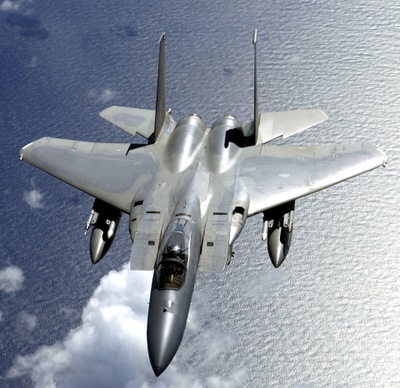
The US Air Force successfully completed a flight test of its experimental synthetic fuel with a fighter for the first time this week by using an F-15 Eagle. The F-15 seemed to take to the new fuel pretty well as it screamed up to Mach 2.2 during a 55 minute test flight. The Air Force has been testing the fuel on larger aircraft in their fleet including a C-17, a B-52 and even a B-1 that was the first to break the sound barrier using the 50-50 blend of synthetic fuel and JP-8. This new test was the first on a light and maneuverable fighter jet, though. The fuel is created by using the proven Fischer-Tropsch method of deriving fuel from coal which is a process the Germans used during WWII to satisfy their insatiable need for war-time fuel. While the synthetic fuel mix is marginally better on the environment than traditional fuel, the main reason the Air Force is conducting this research is to see if it can reduce their need for oil and save Uncle Sam a little money. The US Air Force is, after all, the world's largest consumer of jet fuel which is why they'd like to certify all of their aircraft on the new mix. Next up for testing is the Air Force's newest (and baddest) fighter, the F-22 Raptor, which could start as early as next week.
[Danger Room] [Photo: Op-For]
Home to PointNiner
Nine American Eagle aircraft were grounded today at Chicago O'Hare after they were damaged by a TSA inspector according to ABC News. TSA spokesperson Elio Montenegro confirmed the incident occurred when an inspector was conducting an overnight security check and decided to see if he could climb on top of parked aircraft in order to gain entry into them. Unfortunately, instead of using a ladder, the TSA inspector decided to use the aircraft's sensitive exterior probes to climb up on top. Specifically the TAT (Total Air Temperature) probe was selected as a foot hold. No word on what type of aircraft were damaged but American Eagle pilots were obviously furious with this act and one was quick to post on an online forum, "The brilliant employees used an instrument located just below the cockpit window that is critical to the operation of the onboard computers." Another commented the TSA agents, "are now doing things to our aircraft that may put our lives, and the lives of our passengers at risk." Forty Eagle flights were delayed today as a result of the inspector's action. Montenegro assured that the "inspector was following routine procedure for securing the aircraft that were on the tarmac." Interesting tactic by the TSA as I guess a plane that can't fly is the most secure plane.
[ABC News]
Home to PointNiner

Straight out of a Sci-Fi movie, the Lockheed Martin Cormorant is hands down the coolest idea for a UAV that I have ever seen. I had come across the video below a while ago but hadn't posted it because I couldn't find a suitable version to embed until now. Known as a MPUAV (Multi-Purpose Unmanned Aerial Vehicle) the Cormorant is being designed to launch from 150 underwater on the back of a Trident ballistic missile submarine. Once it reaches the surface booster rockets carry it to a height and speed where the internal jet engine can take over. It can then cruise stealthily and autonomously over enemy territory to engage targets or collect intelligence before landing back in the water where it will be collected by an underwater drone and reeled back into a launch tube. Lockheed Martin sees this as a perfect fit for the US Navy who needs ideas on what to do with some of their Ohio-Class nuclear subs after the signing of Start II, the second strategic weapons reduction treaty. The Cormorant is science-fiction meets science-fact at its greatest. Two divisions within Lockheed Martin are working with the Defense Advanced Research Projects Agency (DARPA) to fulfill my fantasy of seeing the Cormorant get off the ground get out of the water.

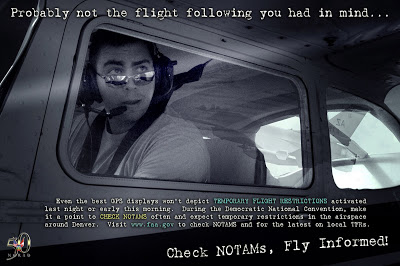
If you routinely fly out of an airport within 100 miles of either Denver or Minneapolis, you might see the poster above tacked to the wall at your FBO this week. These are being distributed to remind pilots of the upcoming Democratic and Republican Conventions and the more important Temporary Flight Restrictions (TFR) that will be associated with them in an attempt to keep the little bug smashers from violating airspace. CONR (Continental NORAD Region), the FAA and the US Secret Service are teaming up to make pilots aware of the TFRs which go into effect from August 25th to September 4th. And for those reckless pilots who don't check NOTAMs, NORAD will have some F-16s out there to "kindly remind you" of where you don't belong.
[AF Link]
Home to PointNiner

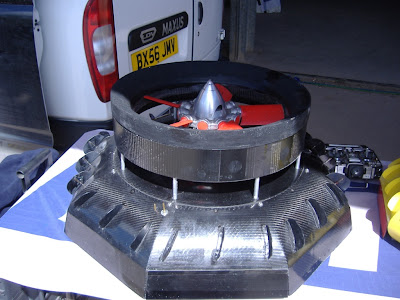
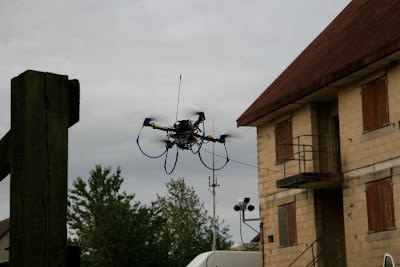
The UK Ministry of Defence kicked off its Grand Challenge competition finals today on Salisbury Plain with 11 competitors vying for the RJ Mitchell Trophy and a potential developmental contract with the UK Armed forces for their UAVs. Each team gets one hour to send their systems (both airborne and ground-based) into Copehill Down village to indetify threats from a mixture of props and real actors portraying enemy combatants. Copehill Down is not actually a real village, but a mockup of a generic European village as a FIBUA (Fighting In Built Up Areas) training ground. While some of the teams competing are relative uknowns, European defence heavyweights like Qinetiq and Thales have also joined the fray. A winner will be picked on the 19th. Here are a few of the entries:
Qinetiq was displaying their Cortex UAV prototype that takes off and lands on its tail, but converts to conventional flying in the air. The competition version had previously crashed. Here is a cool video of it in flight.

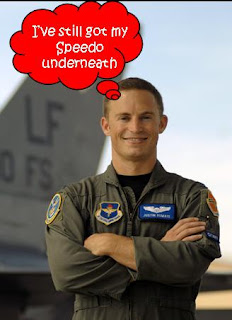
In 2004 Justin Dumais was at the Olympic Games in Athens diving from 3 meters into the water. Now he is diving from 20,000 feet while dropping precision weapons onto targets. The former Olympian used to dive with his brother Troy in the men's synchronized three-meter springboard diving event. Troy is competing again in Beijing for the 2008 Olympics, but Justin has left the diving world for the dog-fighting world and flying F-16s for the South Carolina Air National Guard's 169th Fighter Wing at McEntire Joint National Guard Base in Columbia, S.C. 1st Lt. Dumais is currently attending the Night Systems Training Course at Luke Air Force Base, Arizona while his brother and former partner is participating in an individual diving event in China. While Dumais misses diving and would have loved to compete in the Olympics with his brother again, he is definitely happy with his current gig and believes his diving experiences prepared him for being a Viper driver. "I spent my entire life getting ready for seven seconds of competition," he said. "That is pretty much what we do everyday here flying F-16s. You never know when you will be called to go do your job. Generally, it is in a split second when you need to pickle off a bomb or strafe a target. [Diving] definitely lends itself to what I'm doing now."Remember that emergency landing of Barack Obama's campaign plane last month at St. Louis Lambert? Well the FAA has now released the ATC tapes of the conversation between the pilots and controllers after an emergency slide deployed within the tail cone of the Midwest Airlines MD-81. ABC News called out the airline and the FAA on how serious the incident really was after they both tried to downplay the whole event. It sounded serious enough to me the first time but this is what they found.

It's been almost a year since that Swiss International Air Lines RJ100 landed hard on its rear end at London City Airport but investigators from the Air Accidents Investigation Branch have finally released their findings. It appears that a wind shift, combined with a below normal approach speed led to a sudden sink rate right before landing. In an attempt to stop the sink the pilot instinctively pitched the nose of the RJ up 9.3° which led to a tail strike before the main gear touched down. The violent tail strike cracked nine frames in the aft fuselage, damaged stringers, and obviously by the picture, extensively damaged the tail skin. "The aircraft was already in a low-energy state," says the AAIB. "Then the thrust was reduced and this reduction, and the loss of headwind component, both made the situation worse." London City is known for having one of the most difficult and steepest approaches due to its location and noise sensitivity issues which demands a "high degree of accuracy" especially when it comes to managing final approach speeds. Just check out this video from another Swiss RJ100 as it goes bouncing down the runway after slamming onto the deck at London City. Swiss has already amended its training program for operations at London City to prevent these types of incidents from reoccurring.
[Flight Global]
Home to PointNiner
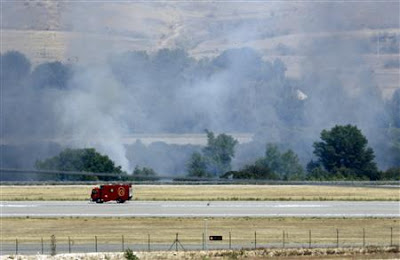
Five months after the FAA started it's maintenance crackdown following the Southwest Airlines debacle, the agency is still at it. This time they've dropped the hammer on American Airlines with a $7.1 million fine for differing safety related maintenance items on their aircraft. They are alleging the airline flew two MD-83s 58 times last December while knowingly using the wrong provisions of its Minimum Equipment List (MEL). For both aircraft, the problems were noted by an FAA inspector or in the pilot's log, however, American maintenance returned both aircraft to revenue service only to make the fixes at a later date. Part of the fine also includes past deficiencies in its drug and alcohol testing programs and for allegedly operating aircraft in past years without timely inspections of emergency escape path lighting systems. The FAA is adamant with the high amount on the fine because they believe "the carrier did not follow important safety regulations intended to protect passengers and crew."
In an unrelated story from the same day, American sealed the deal with Boeing to finalize an order for an additional 26 Next-Generation 737-800s bringing their total on order to 36. The move comes as American desperately tries to jump start it's fleet renewal program amidst high oil prices with a fleet backbone of fuel hungry MD-80s. 
A team from the Air Force Office of Scientific Research has developed a new transparent coating for aircraft and optical elements on aircraft that will repel water by causing it to "to bead up into drops and roll or bounce off a surface." Apparently they've never heard of Rain-X. The Air Force has the intention of using the new coating to prevent corrosion on aircraft and reduce ice formations. Led by Dr. C.J. Brinker the team included the Brinker Nanostructures Research Group at the University of New Mexico and Sandia National Laboratories. Dr. Brinker indicated the technology allows them to control the behavior of the water for a specific behavior that will allow the Air Force to "to define the pathways along which water droplets will roll." The most interesting part of this story is that in addition to keeping water away, the team learned that the technology can be used to combine extremely water-repellent and water-absorbent materials to actually draw moisture out of thin air. The Air Force is envisioning this new method of collecting water without using energy as a means of potentially supplying water to troops where the supply is scarce. According to Brinker, this tactic is allegedly modeled after the Namib Desert beetle which collects water droplets on its back from vapor in the air. The research team will likely transfer the technology to commercial applications so you can plan on waterproofing your iPhone and using it as a canteen in the future.
[AF Link]
Home to PointNiner
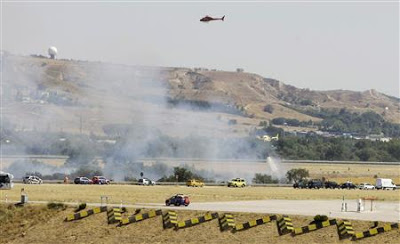
I won't use this blog as forum for debating the developing Russian-Geogian War, but this is what is bound to happen when two former Soviet Socialist Republics go at it. Russian Air Force SU-25 Frogfoot aircraft have now bombed the SU-25 production plant twice at the Tbilisi airport in Georgia according to the blog Ares. The irony is dangerously palpable here.
[Ares via Danger Room]
Home to PointNiner
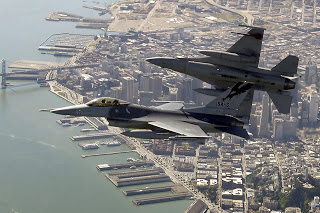
If you've purchased a new cell phone from the Best Buy Express vending machine at the DFW airport recently, you may be able to buy yourself a bluetooth headset to go with it the next time you have a layover in Atlanta. Best Buy, in partnership with ZoomSystems, has announced their intentions of adding a machine there as well as Boston, Dallas, Houston, Las Vegas, Los Angeles, Minneapolis and San Francisco by September 1st. Could there be a more perfect marketing strategy? Beautiful gadgety goodness tempting you from behind glass while you wait for your connection that has already been delayed twice. I don't see a PS3 sitting on one of those rotating corkscrews though.
[Gizmodo]
Home to PointNiner

Never mind the teen pilot who was rescued by using SMS text messaging, this story has got to be epitome of the complete integration of cell phones into our way of life. Five people who were on board a Piper twin-engine aircraft in Ireland know exactly what I'm talking about when they lost complete electrical power last November on their way from Kerry to Jersey. With no way to communicate using radios, the pilot used his cell phone to make contact with air traffic control at the nearby Cork airport. When the pilot lost audio cell phone contact, the quick thinking controller switched to SMS to tell him he had a primary radar signal on the aircraft and that he was cleared to land at Cork International Airport. He continued to use text messages sent to the pilot to aid him in his approach and ultimate safe landing at the airport. I'm pretty sure this means TEOTWAWKI.
[Irish Times via Gizmodo]
Home to PointNiner

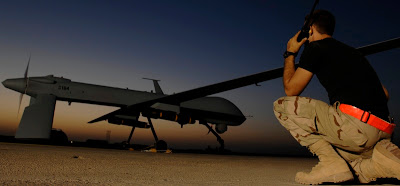
Four months after a highly publicised study reported UAV pilots face more fatigue, emotional exhaustion, burnout and video-game thumb than traditional combat pilots, the US Air Force has decided to do something about it. As with the previous study, this new move will surely have in-theatre combat jockeys riled up. Top Air Force brass has decided to call in chaplains, psychologists and psychiatrists "to help ease the mental strain on these remote-control warriors," the Associated Press reports. Many UAV combat sorties in Iraq and Afghanistan are actually flown by pilots and senor operators here in the United States via remote satellite link. When this scenario first began, many UAV pilots were happy and commented that, "most of the time, I get to fight the war, and go home and see the wife and kids at night." This was until the demand for their operations exploded and their hours became more and more prolonged with new internal comparisons to "prisoners with life sentences." While this is enough to get traditional pilots up out of their seats with expletives (along with every other Army grunt and Marine who spends numerous 15 month rotations in the sandbox getting shot at) some higher ups caution that the back and forth between war and peace is straining these distant drone drivers. "It is quite different, going from potentially shooting a missile, then going to your kid's soccer game," sighs Lt. Col. Michael Lenahan. This is why the 163d Reconnaissance Wing out of March ARB in California is looking to help their crews with whatever emotional or psychological issues that may come up. If it works, then its back to bombing insurgents by day and sleeping in their bed with their wives by night.
[Boston Globe via Danger Room]
Home to PointNiner

The plasma rocket was designed by Frank Diaz, a former NASA astronaut, and it will use solar energy to produce the energy needed for movement. This makes it green and reusable for moving things from low-Earth oribit (from the ISS) to low-Lunar orbit. NASA intends to test this rocket engine in 2011 or 2012 from the ISS platform. Should be pretty awesome considering both the sun and stars are made up of plasma.
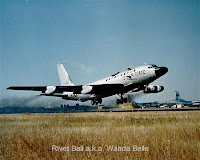
Every now and then I find myself pioneering through the vast unknowns of the world wide web in the eternal search for knowledge and freedom from boredom. Unfortunately there always seems to be a limit to what's available and of interest. On the flip side of that equation, there appears to be an infinite amount of junk on the Internet. One day last year I was looking for information on the web about the tiny Alaskan island of Shemya. Many years ago, I had a friend in the Air Force who was stationed there. Shemya is a fragment of a rock lodged halfway between our world and the Russians amidst the Aleutian Islands that is barely big enough have one runway and a handful of buildings and hangars. As diminutive as it sounds, Shemya actually played a very large role in the security of the United States during the heights of the Cold War. It was during my search for information on Shemya that I found a website with a particular intrigue that keeps drawing me back. The site is called A Tale of Two Airplanes and was authored by a former U.S. serviceman named Kingdon Hawes. Hawes was an Electronic Warfare Officer on a RC-135 Rivet Ball aircraft assigned to Shemya in the 1960s. He tells a story of two very early RC-135 aircraft, Rivet Ball and Rivet Amber, and his unit's adventures at Shemya during our standoff with the Soviets. As a huge fan of both aviation and Cold War espionage, I found the site to be highly fascinating. So much so that I have revisited it several times since I first found the site last year, just to re-read it. Interestingly it turns out that Hawes currently resides in the same metropolitan area as PointNiner, and the successors to Rivet Ball and Rivet Amber live down the street as well at Offutt AFB in the form of Rivet Joint and Cobra Ball aircraft. I don't really do website reviews, but I really felt like sharing this site with whoever else might find the tales interesting in appreciation for Mr. Hawes sharing his stories.
You can check out A Tale of Two Airplanes HERE.
Home to PointNiner

A United Airlines flight declared an emergency and returned to Seattle after takeoff when a row of seats on the Boeing 737 came loose and slid into the row behind it injuring one passenger. Flight 1139 was on the way to San Fransisco when one bolt was loosened during the takeoff, forcing row 3 to come loose from the floor tracks and slide into row 4. A 61 year-old woman was transported to the hospital with a knee injury. FAA spokesman Allen Kinetzer told the Seattle Times that an "airline maintenance crew discovered the loose bolt on the Boeing 737 and fixed it." One bolt? To hold down an entire row of seats? I suppose if you want two bolts on your row you have to pay an additional $25.
(Seattle Times via Today in The Sky)
Home to PointNiner
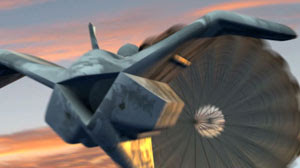
Photo Credit: Stewart Andrew via Airliners.net
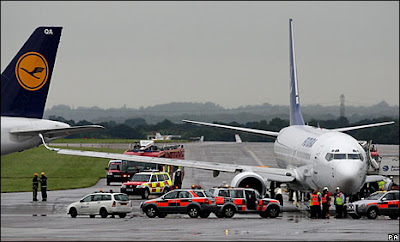
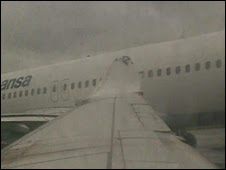
If you click on the above photo to blow it up, you can see where the winglet of the Futura International Airways Boeing 737-800 was clipped off when it contacted the tail of this Lufthansa Airbus A320 that was holding at the runway at Manchester International in the U.K yesterday. The Futura 737 was attempting to taxi behind it. The pilots then exchanged insurance information and were on their way (last sentence untrue).

Other Photos from BBC
Home to PointNiner
Remember that GIANT Emirates A380 model that recently went up outside of London Heathrow? Here's a picture of that 1/3 scale model being loaded into an Antonov AN-124 freighter at the Ontario Airport in California. I doubt you'll ever see a sight like this again. Although, it's kind of what Airbus does now for assembly, but on a slightly smaller scale.
Photo Credit: Dmitry Avdeev
Home to PointNiner

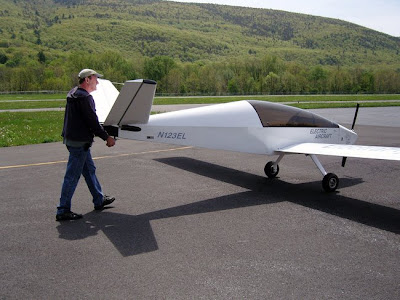
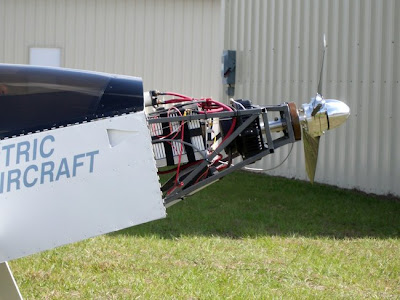
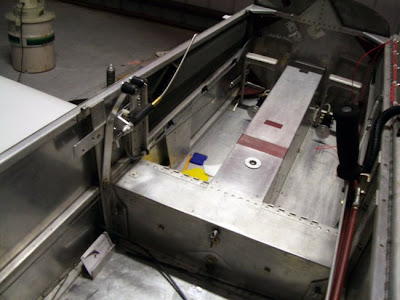
Not to be out done by the Oriens Glider, the ElectraFlyer C may be the greenest airplane to actually take to the skies. Powered by a single 5.6 kWh lithium battery, the ElectraFlyer C can cruise at 70 mph and top out around 90. Range on the aircraft is limited by the charge and can last from 90 to 120 minutes, although I don't think I'd be taking the chance of flying it past 90. The battery in the aircraft can be charged 1,000 time in it's life cycle. Charging can be accomplished with a simple 110V outlet, but can take up to 6 hours. If you've got a 220V outlet handy, the charge only takes 2 hours. The aircraft, which was unveiled at AirVenture last week, is manufactured by the Electric Aircraft Corporation, who is billing as virtually silent and emissions free for all of the eco-friendly pilots out there. The 45 inch PowerFin designed for the aircraft is made of a foam core surrounded by an outer shell of carbon fiber and glass fabric. The best part..."refueling" the aircraft with a full charge will only cost you about 60 cents in an electrical bill.


(Autopia)
Home to PointNiner
Darren McWalters and his bride Katie Hodgson tied the knot today in a fairly unorthodox manner. The two were strapped to the tops of biplanes for the ceremony at RFC Rendcomb Airfield, near Cirencester, Gloucestershire in the U.K. A minister joined them in a lead airplane where he faced the bride and groom to perform the holy ceremony over an airborne communications system that was also played over loudspeakers on the ground for their guests. The bride, who I'm sure was blushing (from the blast of air in her face), even wore a full wedding gown.
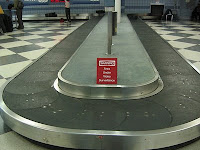
Now here's a lovely story from birthplace and home-away-from-home of this particular blogger. A couple of teenage boys were arrested on Sunday at the Louis Armstrong International Airport in New Orleans after they took a ride on a baggage carousel and ended up in a secure portion of the airport according to the Jefferson Parish Sheriff's Office. The two were charged with unauthorized entry of a business and were held overnight in lieu of $1,000 bond. They had reportedly been sitting on baggage carousel number 5 when it started and transported the teens behind the wall into a "sterile area" of the airport. When an employee told the two to get off the belt, they ignored the request and tried to hide from airport officials in a restroom where they were ultimately found by deputies. Ironically, these two "criminals" were traveling through the airport on a church trip. When the New Orleans newspaper The Times-Picayune tried to make contact with one of the teen's mother the next day for a comment regarding the incident, she told them she wasn't even aware her son had been arrested. Whoops.
The level of irony in this story is dangerously overwhelming. It turns out that there was more to the payload of that recent SpaceX Falcon 1 launch that failed to reach orbit (again). It turns out also on board were the ashes of the late James Doohan, better known to Trekkies as Scotty, the Chief Engineer of the USS Enterprise from the original TV version of Star Trek. Also on board were the ashes of NASA astronaut Gordon Cooper, one of the original Mercury Seven astronauts. Their ashes were to be blasted into low-Earth orbit on the doomed Falcon 1 rocket in a service provided by Celestis, Inc, a company that specializes in memorial spaceflights. As if this story wasn't ironic enough already, this fiasco comes on the heels of an attempt last year to launch Doohan and Cooper on board a suborbital rocket in New Mexico that crash landed magnificently in the mountains of the White Sands Missile Range. After a search and recovery effort in New Mexico that took a week's time, Celestis arranged for the two to hitch a ride on Saturday's ill-fated launch of SpaceX's Falcon 1. The ashes of Scotty, known on the show for giving his starship more power when it was desperately needed, apparently hasn't been enough for his two real world galactic jaunts. Unfortunately, I'm starting to think Scotty's ashes just couldna teek namoore.
(New York Times via Engadget)
Home to PointNiner
It wasn't exactly a good week for SpaceX, what with their Falcon 1 rocket failing to reach orbit...for the third time in a row. But at least they were able to squeak one good piece of news in the few days that has been August. On August 1st the company announced that it had successfully test fired the first Falcon 9 launch vehicle 1st stage consisting of nine Merlin 1C rocket engines. This milestone helped SpaceX complete a major NASA requirement for the Commercial Orbital Transportation Services (COTS) program; in which NASA hopes to use commercial services, like SpaceX and the Falcon 9, to deliver crewmembers and cargo to the International Space Station. The static test firing at their Texas Test Facility outside McGregor had a Falcon 9 first stage burn through 3,200 lbs. of kerosene and liquid oxygen and generated 832,000 pounds of force (lbf). To put it into perspective, that would equate to the maximum thrust of four 747s combined. SpaceX CEO, Elon Musk, said in a statement, “This was the most difficult milestone in development of the Falcon 9 launch vehicle and it also constitutes a significant achievement in US space vehicle development." The company has scheduled the first flight of its heavy lifting Falcon 9 rocket for 2009. Hopefully it will have better luck than it's little brother, the Falcon 1. 
NASA recently released this picture from German amateur photographer Martin Wagner of the International Space Station passing in front of the Sun back in June. Note the Port side solar arrays aimed towards the big ball of fire in order to soak up as much energy as possible.
(NASA APOD via Wired Science)
Home to PointNiner

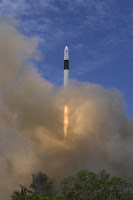
SpaceX, the space start-up founded by PayPal co-founder Elon Musk, hit another snag last night when the third launch of their Falcon 1 rocket failed to reach orbit. This follows previous failures that include an in-flight explosion and another failure to reach orbit with the Falcon 1. If you're a nerd like me and you were watching the live webcast, you noticed that around 2 minutes and 20 seconds into the flight the live video feed was cut. Allegedly the two stages of the Falcon 1 failed to separate after stage 1 burnout. SpaceX hasn't released whether or not the 2nd stage ignited while still attached to the 1st stage, but that would have been an interesting sight. Either way, this setback is a disappointment to Musk and SpaceX though Musk seemed confident in the performance of the 1st stage. Not one to give up, Musk is ready to press on with plans for flight number 4 of the Falcon 1 rocket amidst another investigation as to why number 3 failed to reach orbit. The two stage liquid oxygen and kerosene launch vehicle was carrying two small NASA satellites during the unsuccessful launch from Omelek Island of the Kwajalein Atoll in the Pacific Ocean. Number 4's flight was originally scheduled to take place by the end of this month, but we will have to watch to see how the investigation of number 3 plays into that schedule.
(Space.com)
Photo courtesy of SpaceX
Home to PointNiner
Bombardier's first and only CRJ-1000 broke its cover here and headed out for what looks like a tank of Jet A at Mirabel Airport in Montreal. One thing's for sure...this ain't your daddy's Challenger jet. In fact, it's twice as long! This stretched out flying tube is longer than a classic 737 now. Entry into service is expected next year.
Photo Credit: Justin Jones via Airliners.net
Home to PointNiner
One week after Emirates received their first Airbus A380, the Dubai-based airline gave the United States its first scheduled service of the super jumbo today...and it did not include drinking recycled shower water. The airline had originally planned to take the water from it's now infamous on board showers and have it recycled while airborne and reused for passengers who partake in this service. The idea, seen as a weight saving measure, was shot down by European regulators even though Emirates president Tim Clark claims he "has seen demonstrations of contaminated water being turned to drinking quality following normal and then ultra-violet filtration." If they're trying to create incentive for buying a $5 bottle of water in the air, they're doing a good job here. All of Emirates' three-class configured A380s will have two of these shower-spa cabinets which seem very nice, although sharing this shower with other people on a flight may be an invitation for athlete's foot. The aircraft will now have to carry about 25% more water which means more unwanted in-flight weight. Clark even conceded that Emirates chairman Sheikh Ahmed bin Saeed Al-Maktoum was "not keen" on the idea of using recycled water for showers on their A380s, although he is hopeful regulators will ultimately ease their stance on the issue. Emirates is quite proud of their shower setup that took almost four years to develop this "masterpiece of engineering". But let's be honest now. Who doesn't pee in the shower? Think about that one while you're rinsing off at 37,000 feet.
(Flight Global)
Home to PointNiner

A day after NASA announced it had officially discovered water on Mars (again), the agency alerted the White House that it has plans to make another announcement soon. This one pertains to major new discoveries made by the Phoenix lander that indicate the "potential for life" on the red planet according to Aviation Week & Space Technology. Sources say they have not discovered past or present life on Mars, only the potential for the planet to support life at the site of the Phoenix lander. While the recent discussion of the "discovery" of water has consumed the worldwide media, scientists indicate that more complex data not openly discussed yet contains much more "provocative" results. Allegedly much of this information was specifically withheld so NASA could present these findings to the White House and prepare a further announcement. The Presidential Science Advisor's office in the Bush Administration was informed of this new data as NASA hopes to release it publicly by mid-month or early September as further analysis allows. Scientific instruments on Phoenix do have the capability to detect organic life at the bacterial level, although NASA has said this has not occurred (yet).


British aircraft propulsion manufacturer, Rolls Royce, announced at EAA AirVenture today that they have signed a Memorandum of Understanding (MOU) with US-based General Aviation aircraft manufacturer, Mooney, to discuss future applications for its new RR500 turboprop engine. This development could finally bring Mooney, known for their high performance aircraft, into the turbine single market. Rolls sees their 350 to 450 shp RR500 as an ideal fit for the "the light, fixed-wing general aviation segment." The new micro turboprop even has Harrison Ford a glow.
Image & Story: Rolls Royce
Home to PointNiner